The Clear Quran Live with Ayoub
Follow along with the Quran live — the book, resources, and more
Hey, I'm Ayoub — I read the English Quran live on TikTok, and this page is for anyone who wants to follow along, get the book, or simply learn more.
Follow Along
Get the book, read the Quran online, and explore resources to go deeper.
The Book
💡 Want the spiral binding? You can get it done at local print shops — UPS Store, Staples, Office Depot, or similar. They'll cut the spine and spiral it for you. Just call around places near you and ask.
Free Online Resources
The Quran — Read Online
Read the Quran in English with audio recitation, translation, and scholarly explanations
Order The Clear Quran in English - FREE
One Message Foundation is offering a free copy of the Quran in English
Order The Quran Project Translation
Easy-to-understand English translation made specifically for non-Muslims and beginners. Includes chapter introductions and appendices.
Live Drawing Board — Session Diagrams
Visual diagrams and charts drawn during live sessions — see the concepts mapped out
Authentic Hadith Collections
Explore the traditions and teachings of Prophet Muhammad (ﷺ) with Sunnah.com
Watch & Learn
The Life of Prophet Muhammad — AI Visualized
An animated visual journey through the biography of Prophet Muhammad (ﷺ) with enriching commentary
Stories of the Prophets — Mufti Menk
Learn the inspiring stories of all the prophets from Adam to Muhammad (ﷺ). Be reassured by the divine guidance throughout history
Islam is a monotheistic religion and way of life based on submission to the will of God (Allah). The word "Islam" means submission, peace, and purity. Muslims believe in one God, follow the guidance of prophets throughout history, and seek to live according to divine principles revealed in the Quran.
Reference: "This day I have perfected for you your religion and completed My favor upon you and have approved for you Islam as religion." — Quran 5:3
Tawhid (توحيد) means "oneness" or "monotheism." It is the foundational concept of Islam—the belief that there is only one God (Allah) and nothing is worthy of worship except Him. From Tawhid flows all Islamic belief and practice. This principle frees believers from worshipping false gods, idols, or any created thing, and redirects all devotion toward the one true God.
Reference: "Say, 'He is Allah, [who is] One, Allah, the Eternal Refuge. He neither begets nor is born, Nor is there to Him any equivalent.'" — Surah Al-Ikhlas, Quran 112:1-4
The Five Pillars are the foundational practices of Islam:
- Shahada — Testimony of faith.
- Salah — Prayer five times daily.
- Zakat — Obligatory charitable giving (typically 2.5% of accumulated wealth).
- Sawm — Fasting during Ramadan.
- Hajj — Pilgrimage to Mecca for those who are able.
Reference: "Islam is built upon five [pillars]: testifying that there is none worthy of worship except Allah and that Muhammad is the Messenger of Allah, establishing the prayers, giving zakat, making pilgrimage to the House, and fasting the month of Ramadan." — Sahih Muslim 16c
Salah (صلاة) is Islamic prayer—a formal, structured act of worship performed five times daily. During Salah, Muslims face the Kaaba in Mecca, recite Quranic verses, and perform ritualized movements (standing, bowing, prostration) that signify submission and humility before God. It is a direct spiritual connection with the Creator.
Reference: "Indeed, I am Allah. There is no deity except Me, so worship Me and establish prayer for My remembrance." — Quran 20:14
The Shahada is the Islamic declaration of faith: "I testify that there is no god worthy of worship except Allah, and I testify that Muhammad is the messenger of Allah." To become Muslim, one sincerely recites the Shahada with intention and belief. There's no complex bureaucracy needed—just honest faith and sincerity in the heart.
Reference: "Allah witnesses that there is no deity except Him, and [so do] the angels and those of knowledge..." — Quran 3:18
Ramadan is the Islamic month of revelation. During this month, Muslims fast from dawn to sunset. Fasting trains the soul, builds empathy for those living in poverty, strengthens self-discipline, and brings the believer closer to God by reducing physical distractions.
Reference: "O you who have believed, decreed upon you is fasting as it was decreed upon those before you that you may become righteous." — Quran 2:183
Muhammad ibn Abdullah (c. 570-632 CE) is the final prophet in Islam. Muslims believe he received divine revelation from God through the angel Gabriel, which became the Quran. He is the ultimate example for Muslims in terms of character, morality, and how to practice the faith. Muslims revere him deeply but do not worship him.
Reference: "And We have not sent you, [O Muhammad], except as a mercy to the worlds." — Quran 21:107
The Quran is Islam's primary sacred text, believed by Muslims to be the verbatim word of God. It covers theology, ethics, justice, stories of previous prophets (like Jesus, Moses, and Abraham), and spiritual guidance for everyday life.
Reference: "This is the Book about which there is no doubt, a guidance for those conscious of Allah." — Quran 2:2
The core Islamic teachings heavily emphasize justice, mercy, and the protection of life. The vast majority of Muslims practice the faith as a path of inner peace and societal harmony. Unjustified violence is strictly prohibited.
Reference: "...Whoever kills a soul unless for a soul or for corruption [done] in the land - it is as if he had slain mankind entirely. And whoever saves one - it is as if he had saved mankind entirely." — Quran 5:32
Absolutely. Exploring Islam through reading the Quran, visiting a mosque, or asking questions is highly encouraged. Islam respects human intellect and the journey of seeking knowledge. There is no pressure to convert if you are simply learning.
Reference: "There shall be no compulsion in [acceptance of] the religion. The right course has become clear from the wrong..." — Quran 2:256
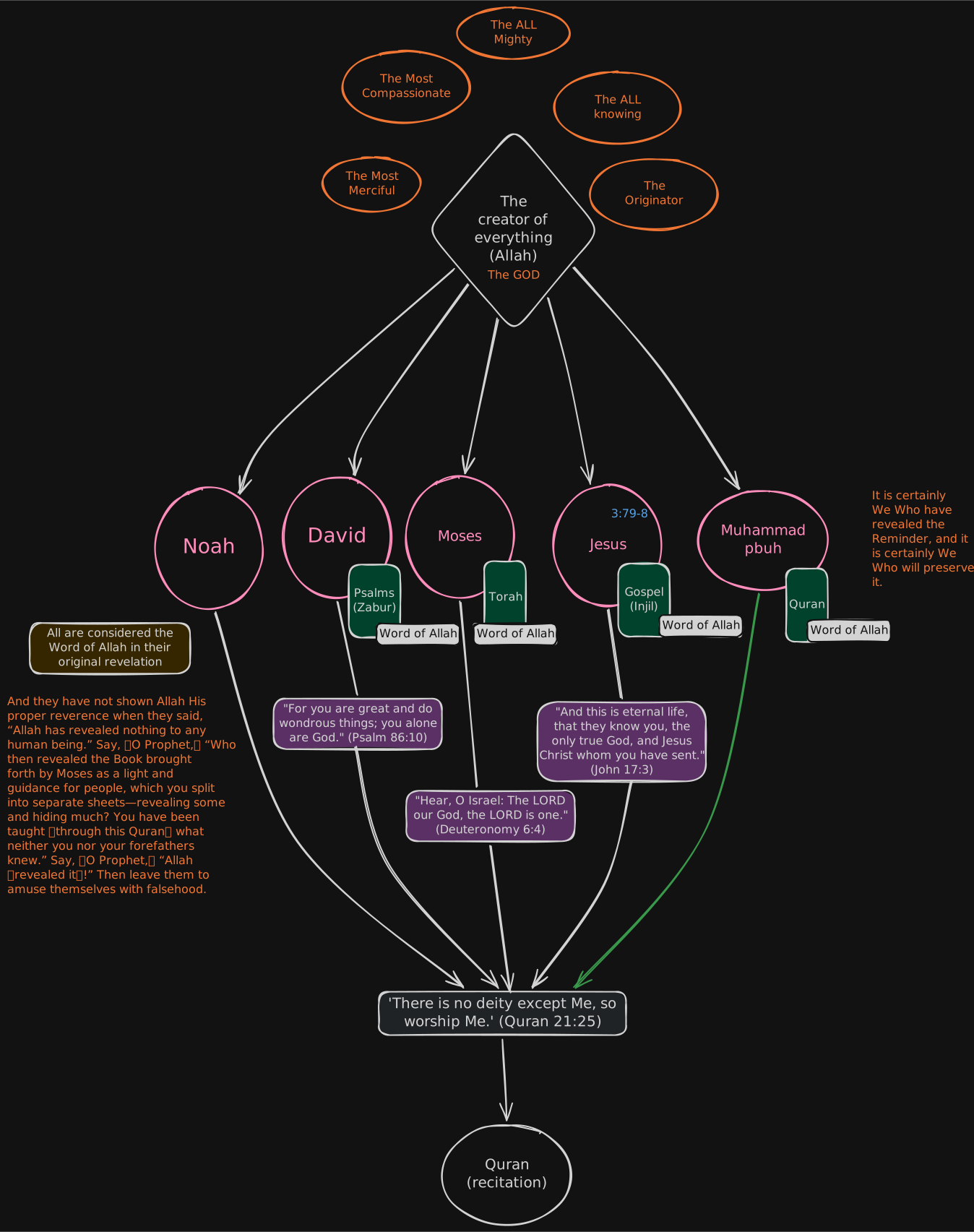
A visual guide understanding the lineage of Prophets and their shared core message through history.
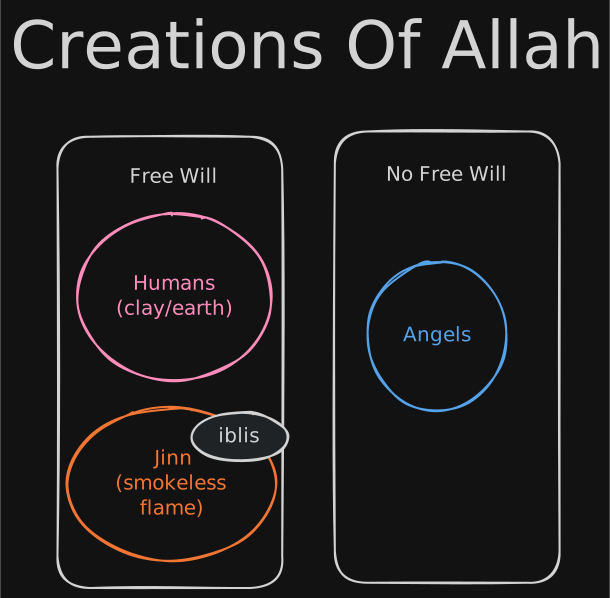
A visual exploration of three of Allah's most significant creations: Angels, who are made of light and have no free will — they obey Allah perfectly and without question. Jinn, who are made of smokeless fire and, like humans, were given free will — they can choose obedience or disobedience. Humans, created from clay, also gifted with free will and entrusted with a unique responsibility on earth. Understanding these three helps clarify the Islamic worldview of choice, accountability, and purpose.